
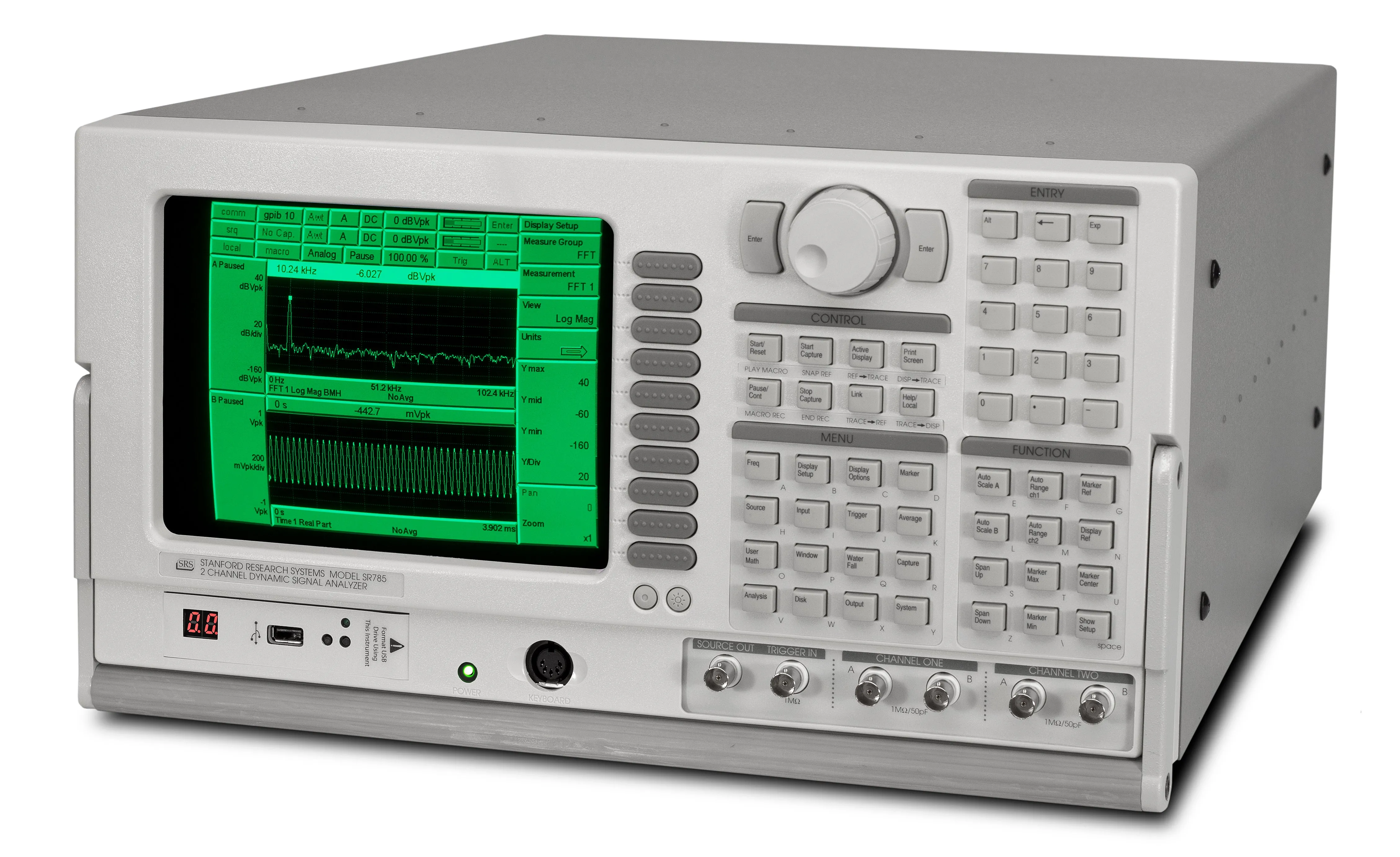
Stanford SR785 Analyzátor dynamických signálů
Stanford SR785 Dynamic Signal Analyzer
Vyžádat cenovou nabídku
Stanford SR785 je duální analyzátor dynamických signálů s šířkou pásma DC až 102,4kHz, dynamickým rozsahem FFT 90dB (145dB zametáním sinusem), pokročilou FFT, oktávovou a analýzou sledování řádu.
Podrobnosti o produktu
| Model | SR785 |
| Výrobce | Stanford |
| Kategorie | Generátory signálů RF a mikrovln |
| Dostupnost | Na objednávku |
Popis
Přehled
Stanford SR785 je přesný duální analyzátor dynamických signálů poskytující nejmodernější výkon pro měření mechanických a elektrických systémů. Kombinuje schopnosti analyzátoru spektra, síťového analyzátoru, analyzátoru vibrací, oktávového analyzátoru a osciloskopem v jednom přístroji se šířkou pásma DC až 102,4kHz, dynamickým rozsahem FFT 90dB a dynamickým rozsahem zametáním sinusem 145dB pro mimořádnou přesnost měření.
Klíčové vlastnosti
- Duální kanálová konfigurace s nezávislým rozsahem a řízením frekvence na kanál
- Šířka pásma: DC až 102,4kHz se sběrem dat nepřetržitě v reálném čase
- Dynamický rozsah: 90dB (režimy FFT a Oktáva), 145dB (režim zametání sinusem)
- Sledování řádu s delta řádem od 0,0075 do 1
- Analýza oktávy v reálném čase (1/1, 1/3, 1/12 oktáva) podle standardu ANSI S1.11-1986
- Režimy měření: FFT, čas/histogram, korelace, oktáva, zametání sinusem, sledování řádu
- Měření frekvenční odezvy, koherence a spektrální hustoty výkonu
- Přizpůsobení křivky 20-pól/20-nula a syntéza
- Paměť až 32 Mbyte s volitelnou schopností zachycení 2 nebo 8 Msamples
- Pokročilé funkce značek včetně hledání vrcholu, harmonických, pásma a postranních značek
- Rozhraní GPIB a RS-232 pro dálkové řízení a export dat
Aplikace
- Analýza mechanických vibrací a modálů
- Charakterizace řídícího systému a testování frekvenční odezvy
- Diagnostika strojů a detekce poruch
- Akustická a zvuková měření pomocí filtrů vážení
- Analýza přenosové funkce a koherence
- Analýza harmonických elektrizační soustavy a testování kvality
Specifikace
| Averaging | The SR785 comes equipped with a wide selection of averaging techniques to improve your signal-to-noise ratio. RMS averaging reduces signal fluctuations, while vector averaging minimizes noise from synchronous signals. Peak hold averaging is also available. Both linear and exponential averaging are provided for each mode. Because the SR785 is so fast, there's no need for a separate "fast averaging" mode. For instance, in a full-span FFT measurement with a 4 ms time record, 1000 averages take exactly 4 seconds, during which the SR785 still operates at its maximum display rate. For impact testing, the average preview feature allows each time record or spectrum to be accepted or rejected before adding it to the measurement. |
| Order Tracking | Order tracking is used to evaluate the behavior of rotating machinery. Measurement data is displayed as a function of multiples of the shaft frequency (orders), rather than absolute frequency. Combined with a waterfall plot, the SR785 provides a complete history or "order map" of your data as a function of time or rpm. Using the slice feature, the amplitude profile of specific orders in the map can be analyzed. In tracked order mode, the intensity of individual orders vs rpm is measured. Unlike other analyzers, there's no need to track a limited number of orders to ensure full speed measurements. The SR785's speed allows simultaneous tracking of up to 400 orders. Run-up and run-down measurements are available in both polar and magnitude/phase formats. RPM profiling is provided to monitor variations of rpm as a function of time. A complete selection of time and rpm triggering modes is included, allowing you to make virtually any rotating machinery measurement. |
| Octave Analysis | Real-time 1/1, 1/3 and 1/12 octave analysis, at frequencies up to 40 kHz (single channel) or 20 kHz (two channel), is a standard feature of the SR785. Octave analysis is fully compliant with ANSI S1.11-1986 (Order 3, type 1-D) and IEC 225-1966. Switchable analog A-weighting filters, as well as A, B and C weighting math functions, are included. Averaging choices include exponential time averaging, linear time averaging, peak hold, and equal confidence averaging. Broadband sound level is measured and displayed as the last band in the octave graph. Total power, impulse, peak hold and Leq are all available. Exponentially averaged sound power (Leq) is calculated according to ANSI S1.4-1983, Type 0. Octave displays can be plotted as waterfalls with a fast 4 ms storage interval. Once data is stored in the waterfall buffer, the SR785 can display centile exceedance statistics for each 1/1, 1/3 or 1/12 octave band, as well as for Leq. |
| Swept-Sine Measurements | Swept-sine mode is ideal for signal analysis that involves high dynamic range or wide frequency spans. Gain is optimized at each point in the measurement, producing up to 145 dB of dynamic range. A frequency resolution of up to 2000 points is also provided. Auto-ranging can be used with source auto-leveling to maintain a constant input or output level at the device under test (to test response at a specific amplitude, for instance). Auto-resolution ensures the fastest possible sweeps and adjusts the frequency steps in the scan based on the DUT's response. Phase and amplitude changes that exceed user-defined thresholds are measured with high frequency resolution, while small changes are measured using wider frequency steps between points. A choice of linear sweeps with high resolution, or logarithmic sweeps with up to eight decades of frequency range, is provided. |
| Time/Histogram | The time/histogram measurement group is used to analyze time-domain data. A histogram of the time data vs. signal amplitude is provided for accurate time domain signal characterization. Statistical analysis capabilities include both probability density function (PDF) and cumulative density function (CDF). The sample rate, number of samples, and number of bins can all be adjusted. |
| Time Capture | The SR785 comes with 8 Mbytes of memory (32 Mbytes optional). Analog waveforms can be captured at sampling rates of 262 kHz or any binary sub-multiple, allowing you to optimize sampling rate and storage for any application. For example, 8 Msamples of memory will capture 32 seconds of time domain data at the maximum 262 kHz sample rate, or about 9 hours of data at a 256 Hz sample rate. Once captured, any portion of the signal can be played back in any of the SR785's measurement groups except swept-sine. The convenient Auto-Pan feature lets you display measurement results synchronously with the corresponding portion of the capture buffer to identify important features. |
| Source | The SR785 comes with six precision source types: low-distortion (-80 dBc) single or two-tone sine waves, white noise, pink noise, chirp, and arbitrary waveforms. The chirp and noise sources can be bursted to provide activity over a selected portion of the time record for FFT measurements, or to provide impulse noise for acoustic measurements. The digitally-synthesized source produces output levels from 0.1 mV to 5 V plus DC offset from 0 to ±5 V, and delivers up to 100 mA of current. Arbitrary waveform capability is standard with the SR785. Use the arbitrary source to playback a section of a captured waveform, play a selected FFT time record, or upload your own custom waveform from your computer. |
Vyžádat cenovou nabídku
Stanford SR785 Analyzátor dynamických signálů
Odpověď do 24 hodin
Bez závazků
Přímý kontakt